A gaming and privacy browser.

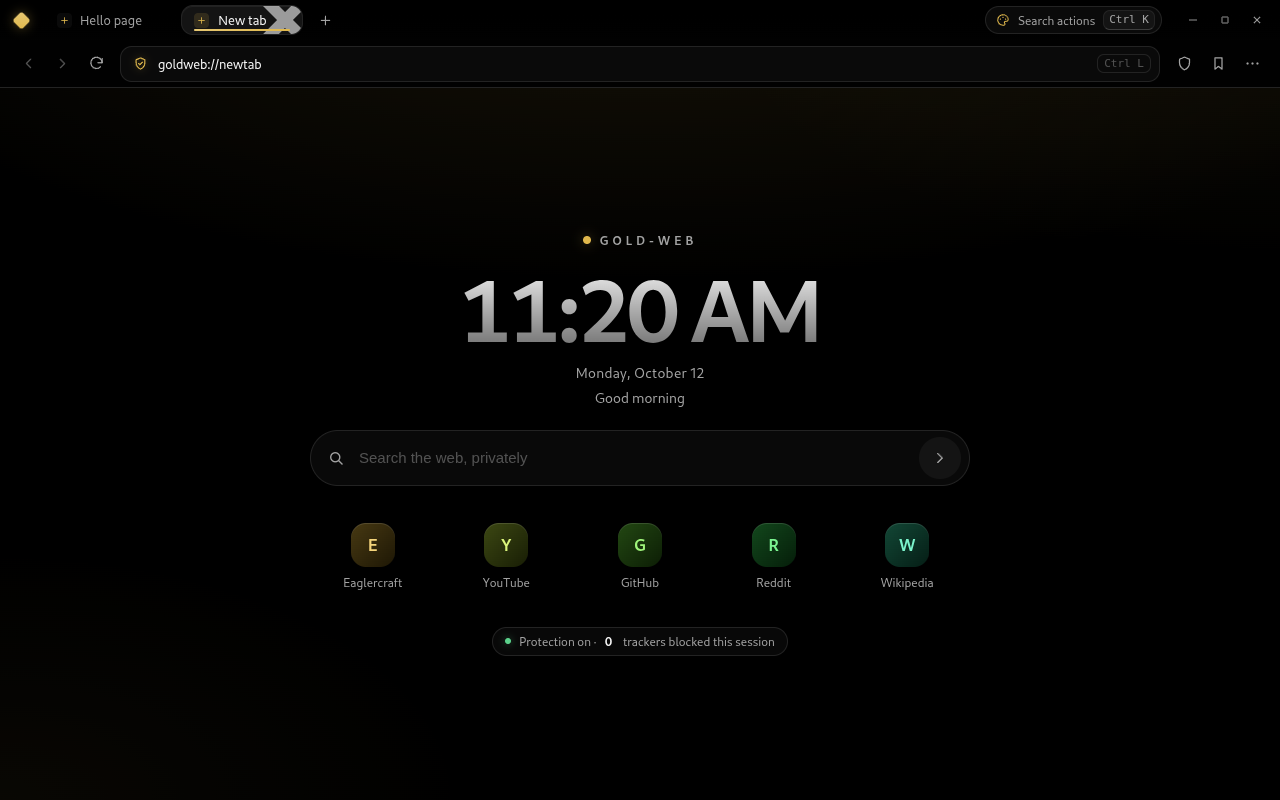
Sleek and stylish. Gold-Web renders the web with Chromium’s engine, embedded through CEF. The window, the tabs, the interface and the privacy defaults are ours.

The Gold-Web window: title bar, tab strip, address bar and a new tab page, all in black and gold.
A sneak peek of absolute cinema.

We are cr browses. See what works.

What it is

Built from scratch by our amazing developer team.

Gold-Web doesn’t restyle Chrome or patch Firefox. It embeds the Chromium Embedded Framework and builds the browser around it.

Chromium’s engine, without Chrome’s habits

Pages render exactly as Chromium renders them, so WebGL and WebAssembly games like eaglercraft get the same treatment they would in an ordinary Chromium browser. What Gold Web doesn’t take on is Chrome’s telemetry, its sponsored tiles, or the parts of the interface that watch you.

Our interface, our policy

The window, tabs, address bar, menus, our pages and the privacy policy are written by us: a C++ shell with a closed web interface. The interface draws the browser. It doesn’t get to decide what’s private.

Yours to restyle

Every colour, corner and spacing value is a design token. Twelve presets ship, and switching between them, or inventing your own, is a data change rather than a rewrite.
Privacy

Privacy, stated honestly.

The interface keeps one rule: never dress up a claim it can’t back up. So here is the plain version.

Blocks known trackers. Not “makes you anonymous”.

True today

  • Tracker and ad blocking: a curated host list, applied to subresources before they leave the machine. A first cut, with a hand-curated list and no per-site control yet.
  • Nothing Gold-Web adds sends anything anywhere. No accounts, no sync, no usage reports.
  • No sponsored tiles and no “recommended” anything.
  • History kept on your device, in a small file beside the profile.

What it doesn’t claim

  • It doesn’t make you anonymous, and it isn’t a network you route through. It blocks known trackers; it won’t hide you from a site that already knows you.
  • It won’t defeat a determined fingerprint.
  • Blocking is a curated list, not a promise to catch everything.
  • Today it’s a first cut: a curated list, subresources only, no per-site control yet.

Gold UI

Black surface, one gold accent, used sparingly.

The default theme is deliberately flat: no gradients, no glass, no decorative shadow. Deep black panels and a single gold for anything interactive or on. If everything glows, nothing communicates.

  • Void#000000
  • Surface#0a0a0a
  • Raised#141414
  • Text#f5f5f5
  • Secondary#a3a3a3
  • Accent#e0b84c

What you can change

  • Preset: twelve named themes, from Gold to Daylight.
  • Accent: any colour. The rest of the scale is derived from it, and contrast is computed rather than hardcoded.
  • Tone: how black the surfaces are.
  • Corners, density, motion and transparency, from square to round, compact to spacious, full to off.
  • Background: solid, aura, mesh, grid or image, tinted from your accent.

Why it holds together

The interface only ever reads tokens. No component knows a setting exists, or what colour a preset picked. It asks for an accent or a radius and gets a value, which is why a new theme is a data change and nothing drifts out of alignment when you pick one.

Status

Where it is today.

Gold-Web is early and Linux-first. The roadmap is public and updated as things land.

Working today

  • A frameless window with our own title bar and window buttons.
  • Tabs, each backed by its own real browser: open, close, switch and drag to reorder.
  • The tab strip can sit on the top, left or right edge.
  • Back, forward, reload, stop and search from the address bar.
  • Our own new-tab and home pages, with no feeds and no sponsored tiles.
  • Keyboard shortcuts that work while a page has focus.
  • On-device history: a searchable list of every visit, clearable in one action.
  • Tracker blocking, first cut, with counts in the Protection Centre.
  • Every surface follows the theme, live.

Next

  • A per-site shield: see and change what’s blocked for one site.
  • Data controls: cookies, cache and site data, reviewed and cleared.
  • Encrypted DNS with a named resolver you can choose, and an HTTPS-only mode.
  • A page that shows exactly what Gold-Web itself connects to, and CEF’s own background services switched off.
  • A fingerprinting self-test that explains what it changes and what it can’t.
  • Workspaces, bookmarks, downloads and passwords.
  • Linux packages (.deb, AppImage, Flatpak) and signed updates.
  • Windows, via the same CEF engine.

Build it

Four commands from a clean checkout.

You need a C++ toolchain, CMake, Ninja, and the CEF binary distribution that the fetch script pins.

./scripts/fetch-cef.sh
cmake -S app -B build -G Ninja -DCMAKE_BUILD_TYPE=Release
cmake --build build
./build/goldweb

Linux only for now. Windows and macOS are planned for v1.0. Full detail lives in docs/BUILDING_LINUX.md.

Authors

Who builds it.

Gold-Web is built by hand, by the both of us, in the open.

  • Choice21

    Choice21

    Systems Engineer & Developer (Blud hasn't done shi btw)

  • French

    French

    I like coding